


Singing Fountains in Sochi
The Singing Fountains in Sochi are one of the resort’s most iconic landmarks and the main evening attraction for visitors to the Imeretinskaya Lowland. Every day during the warm season, thousands of spectators gather here to watch powerful water jets rise and move in sync with music and colorful lighting, creating the effect of a real theatrical performance. The complex is located next to Olympic Park, surrounded by sports arenas, museums, and walking areas, just a few minutes’ walk fr om the Black Sea. Behind the apparent ease of the water dance lies carefully coordinated engineering work and artistic staging, which together have made this show one of the brightest symbols of leisure in Sochi.
History of the Singing Fountains in Sochi
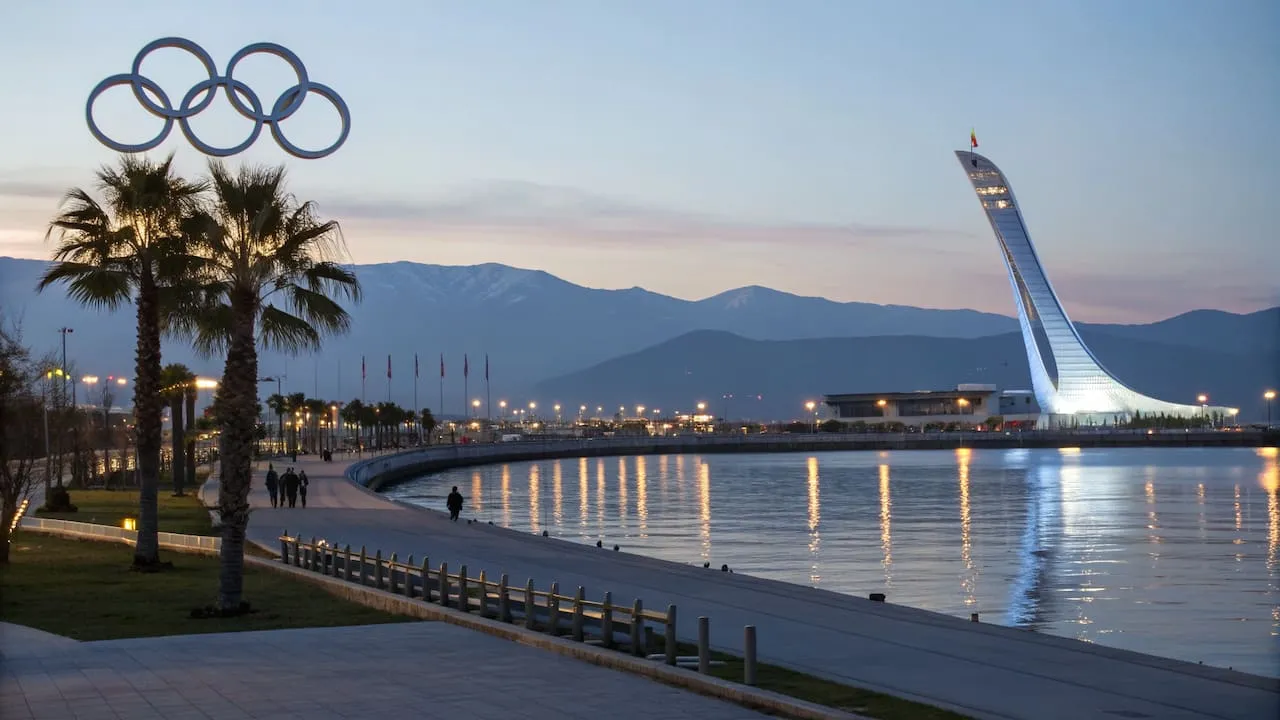
The Singing Fountains in Sochi were created specifically for the XXII Winter Olympic Games in 2014 and became one of the key architectural symbols of the Imeretinskaya Lowland. Construction began in spring 2012, led by the Russian company Stroy International in collaboration with the international design firm WET Design, known for its world-famous fountain shows in Dubai, Las Vegas, and Singapore.
The fountain was originally conceived as the central feature of Olympic Park. Its large bowl became the site of the Olympic flame during the opening and closing ceremonies, while the Firebird-inspired design referenced Russian folklore and the ideas of resilience, renewal, and unity. The “wings” framing the bowl symbolically emphasized both the unifying power of sport and the country’s cultural heritage.
The engineering foundation of the complex is impressive in scale:
-
264 nozzles power the fountain system,
-
including six hyper-jets capable of shooting water up to 70 meters,
-
while the remaining 246 nozzles create mid-level effects up to 30 meters.
The lighting setup includes hundreds of RGB LED projectors, and the entire system is controlled from a single central console.
Construction took place under challenging conditions due to high humidity and proximity to the sea, requiring enhanced corrosion protection and adaptation of engineering solutions to Russian safety standards. The first test runs took place in December 2013, and after the Olympics, the fountain complex was preserved as one of the area's main attractions.
Today, the Singing Fountains are considered one of the most visited sites in Sochi: millions of tourists come here every year to watch evening shows set to classical music, popular soundtracks, and themed programs. The fountain’s distinctive silhouette often appears on souvenirs and in tourism materials, firmly establishing it as one of the true symbols of the resort.
Musical Shows of the Singing Fountains
The light-and-music complex at the base of the Olympic Flame Bowl transforms into a living sculpture, changing colors and moving in sync with the selected melodies. During each performance, water, mist, and lighting create the impression that the enormous fountain is obeying an invisible conductor. A new show begins every 30 minutes, each with its own atmosphere and unique visual composition.
The musical program covers a wide range of genres. At different times, visitors can hear works by Tchaikovsky, Shostakovich, Khachaturian, and fragments from classical operas and ballets — including Swan Lake, The Nutcracker, Eugene Onegin, and Ruslan and Lyudmila. Throughout the week, the shows follow a thematic schedule:
-
Monday — Russian classical music
-
Tuesday — film soundtracks
-
Wednesday — Viennese waltzes
-
Thursday — popular hits
-
Friday — masterpieces by great composers
-
Saturday — jazz selections
-
Sunday — Spanish and Latin American rhythms
As night falls, the square around the fountain becomes an atmospheric space wh ere the LED-lit jets resemble a festive firework display. Reflections shimmer across the water like a starry sky, while a light mist adds a theatrical touch. It is the evening shows that make the Singing Fountains one of Sochi’s most spectacular attractions.
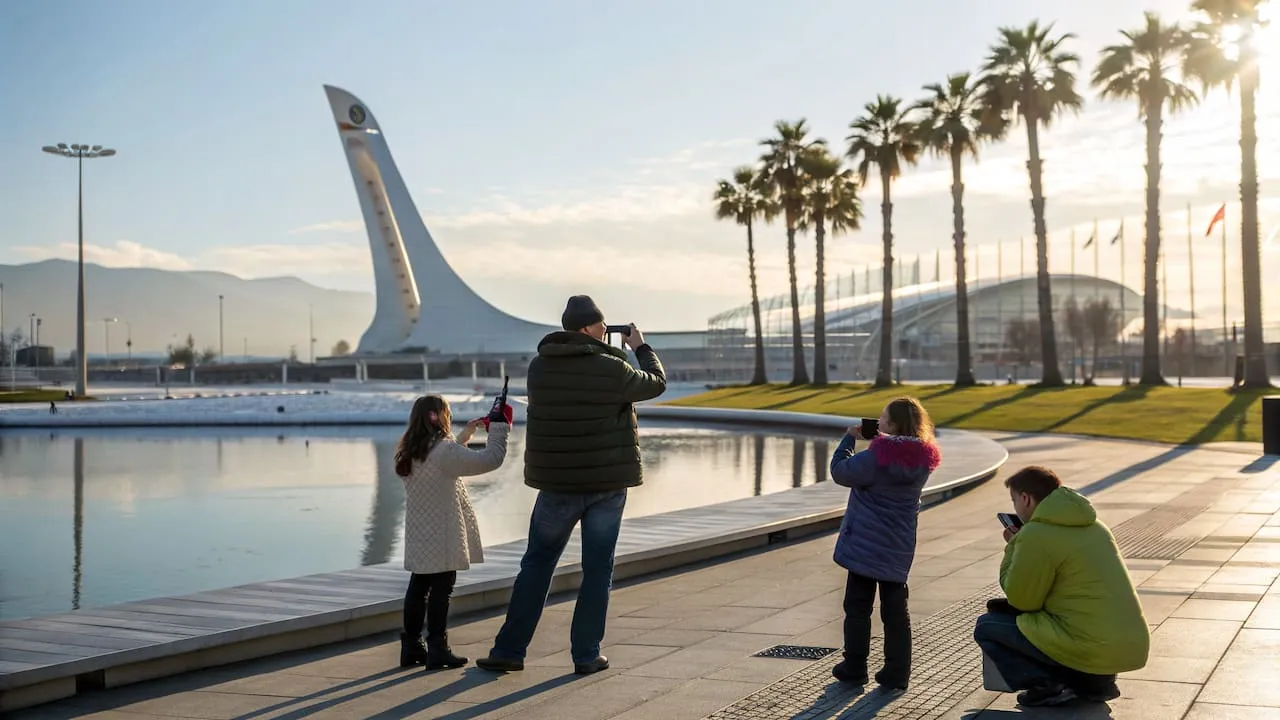
During the day, the fountain looks impressive, but the most striking photos come at sunset or after dark. The best viewpoints are fr om the grassy areas, wh ere families can comfortably watch the show. For dynamic shots, it’s worth moving closer to the central bowl — the moment when the jets soar to their maximum height makes photos and videos especially dramatic.
Interesting Facts About the Singing Fountains and Olympic Park
The Singing Fountains in Sochi are surrounded not only by beautiful visual effects but also by fascinating stories. Each season, tourists throw coins worth several million rubles into the bowl. These funds are used for ecological projects, including the planting of coniferous trees — this is how the “Olympic Grove” of five thousand pines was created. There is another tradition associated with the fountain: to ensure your return to Sochi, simply toss a coin into the water — a superstition that has become very popular among visitors.
A time capsule with a message from the builders of 2013 is buried beneath the complex. It is planned to be opened in 2034, making the fountain not only part of the cultural landscape but also a historical monument of the Olympic era. Excavation work around the park also led to remarkable findings: in 2010, a Byzantine church from the 9th–10th centuries was discovered in the Imeretinskaya Lowland. Today it is located in the Southern Cultures Park and included in guided tour routes. The pattern on the railings surrounding the fountain is inspired by ancient Greek mosaics — a reference to ancient Colchis, to which these lands once belonged.
Sochi’s subtropical climate allows light-and-music performances to run year-round. Daytime shows start every 30 minutes, and the evening program lasts about an hour; the exact start time depends on daylight hours. Visitors should note that the walk from the entrance of Olympic Park to the fountain takes around 30 minutes. For safety and comfort, electric scooters are restricted in the fountain area during showtimes.
What to See Near the Singing Fountains
Singing Fountain (“Olympic Flame Bowl”)
The main landmark of Olympic Park and one of the symbols of modern Sochi. The water complex is designed in the shape of a Firebird, with wide “wings” and a curved “crest.” Powerful jets of water perform smooth and dynamic movements, rising dozens of meters into the air before falling into a circular basin 75 meters in diameter. LED lighting turns the sprays into colorful flashes, while a light mist adds mystery to the entire show.
Sirius Planetarium
Just 500 meters from the fountain is one of the most advanced planetariums in Russia. A giant 26-meter dome, laser projectors, and popular science programs introduce visitors to the history of the Universe, the origins of the Solar System, and modern space research. The planetarium also features shows involving the legendary Buran spacecraft.
Rainbow Bridge
One of five pedestrian bridges in Olympic Park, each designed in the colors of the Olympic rings. It is a popular spot for walks and photoshoots: the bridge offers beautiful views of the park, sports venues, and the fountain bowl.
Shayba Arena
Located about 400 meters southwest of the Singing Fountains, this sports complex seats 7,000 spectators and stands out with its modern design. At night, the arena looks particularly impressive thanks to its well-planned lighting system.
Bolshoy Sports Palace
The largest sports and cultural venue in the district is located west of the fountain. With a capacity of around 12,000 people, it now serves as the home arena for the Sochi hockey club and regularly hosts major sporting events and concerts.
Singing Fountains Throughout the Year
The light-and-music show in Olympic Park runs year-round, and each season gives the spectacle its own special charm. In summer, it can be hot in the open area, so it’s a good idea to bring a hat and water. In winter and during the off-season, cool winds are common, so dressing warmly is recommended — the space around the fountain is completely open.
Once a month, the complex is stopped for several days for maintenance. The current schedule and dates of show cancellations are published on the official website of Olympic Park. There you can also check the updated musical program: it changes daily and depends on the day of the week and the season. On Mondays, Russian classical music is played; on Saturdays — jazz compositions; and during the New Year holidays, the repertoire is selected to highlight the festive winter atmosphere.
Where to Take Beautiful Photos
The best photos of the Singing Fountains are taken near the central bowl — from there you can clearly see the jets reaching their maximum height and creating the most vivid lighting effects. The fountain is interesting to shoot during the day as well, but the most expressive shots are captured in the evening when the illumination is on.
Great angles also open up from the grassy lawns surrounding the complex — families with children often gather there, and it’s a comfortable spot to watch the entire water choreography. If you want a truly spectacular shot, wait for the climax of the show: at that moment the jets soar the highest, and the LEDs create rich, colorful transitions. Videos recorded at this point also turn out dynamic and impressive.
Useful Information for Tourists
Ticket Price Visiting Olympic Park and watching the Singing Fountains show is completely free. Entry to the area is open to everyone, so you can enjoy the light-and-music performance at no cost.
Opening Hours The evening Singing Fountains shows take place daily and last about one hour. Each segment runs for 5–7 minutes, and the start time depends on the season and daylight hours. The first show begins immediately after sunset.
Seasonal Schedule:
-
January – February: 18:00–19:00
-
March – April: 19:00–20:00
-
May: 20:00–21:00
-
June – August: 21:00–22:00
-
September: 20:00–21:00
-
October: 19:00–20:00
-
November – December: 18:00–19:00
Keep in mind that the schedule may change depending on weather conditions. During strong winds or maintenance work, the show may be shortened or temporarily canceled.